Workpackage structure for the IDEMA project
Figure 1. Structure of the workplan
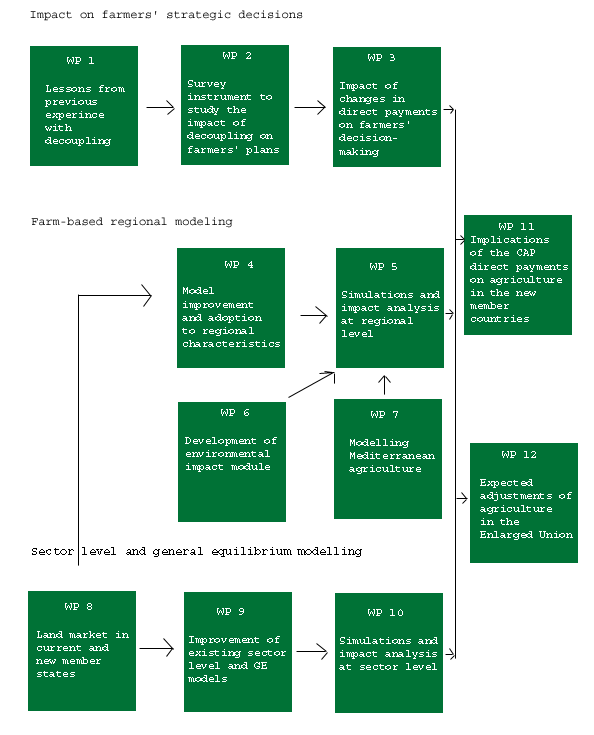
Compared with the previous CAP reforms, the introduction of a single payment per farm implies a fundamental change in policy institutions. Due to the scale and the nature of the change it is extremely difficult to foresee the impact that the reform may have on the relevant aspects of European agriculture. In particular, no single methodological approach is able to accomplish such a task. Therefore, the project is organised around three complementary and inter-related approaches. These approaches include (a) survey-based analysis of the strategic behaviour of farmers, (b) dynamic farm level/regional modelling and, (c), sector/general equilibrium modelling. The work is organised into 12 workpackages. A broad summary of the workpackages and the relations between them is presented below. Figure 1 illustrates the workpackage structure.
Workpackages 1-3 are related to the potential changes in strategic decision making by farmers that may be brought about by the decoupling of aid and the introduction of a single farm payment. WP1 will focus on producing an inventory of previous experiences with decoupling. Past experiences in the EU and elsewhere focusing on the impact on insurance and wealth effects of previous payments will be summarised. Fundamental concepts of decoupling will also be reviewed. WP 1 includes an assessment of experiences in Sweden, where, following a reform of agricultural policy in 1990, a radical form of decoupled payments was applied. In addition, On the basis of this analysis, the main research hypotheses will be formulated. These hypotheses will be subsequently tested in WP2 and WP3.
Workpackage 2 will develop instruments to be used in the survey work, which will be undertaken within workpackage 3. The survey work will be conducted in 5 selected countries (France, Lithuania, Slovakia, Sweden and the United Kingdom). It will be based on sub-samples of the national FADN population in each of the studied countries in order to be able to analyse farmers' responses in conjunction with current and historic records of farm performance and structure. The strategic decisions of farmers, classified by different farm types, in the light of decoupling will be modelled. Previous enterprise level modelling of strategic decision-making has largely concentrated on family farms, whereas this project will analyse both individual and corporate farms. This is an important contribution of the proposed work as the latter will become a far more prevalent organisational form given the enlargement of the EU. Moreover, little attention has been given to understanding how strategic responses to decoupling will vary according to different farm structural and managerial characteristics.
The analysis of the survey data will be expanded by an analysis of the matching farm accountancy data from previous years. The analysis of FADN data will provide information on the financial performance, and particularly the financial stress, of farms and will define whether there is a correlation with particular types of responses. All these aspects of the analysis will be conducted on a country per country basis. To conclude, the commonalities and differences amongst the EU members will be drawn.
Workpackages 4-7 relate to farm-based regional modelling using an agent-based dynamic model. They will involve the detailed modelling of farm-level technologies. Such detailed modelling is necessary because farmers will be confronted with a multiplicity of incentives, which occasionally may be conflicting. Specific cultivation will no longer be required as a condition for receiving support, but farmers will have to comply with animal welfare, environmental protection, food and occupational safety requirements. Moreover, environmental support measures, which are extensively used in several member states and which are expected to remain in place (and even grow), are indirectly related to production due to the relatedness of agricultural and environmental goods. The complicated interplay of the aforementioned factors may result in a very different supply response and contrasting environmental and social impacts in different parts of the enlarged Europe. Hence, detailed modelling reflecting regional diversity is necessary.
Workpackage 4 encompasses the core tasks to be undertaken regarding farm level modelling. This will be based on AgriPoliS, which is an existing model undergoing continuous developments. By taking into account the behaviour of an individual farm and the interaction between a large number of farms, AgriPoliS is able to simulate the effects of policy changes (production, structural change, environment, incomes etc) at the regional level. AgriPoliS will be adapted to analyse different types of decoupling policies. This adaptation will involve two phases: development of the model and adjustment of the model to selected regions. The development of the model is split into three main tasks. First, the incorporation of the behaviour of different types of farm (corporate, co-operative, family) and owners of production factors such as land. This will be based on the experiences from WP1, WP3 and WP8. Second, the model will be adjusted to accommodate different types of decoupling policies. Third, the model will be refined to enable project partners to deliver regional data as well as to calibrate the model. The second phase will be to adapt AgriPoliS to represent agriculture in selected regions. Regions will be selected, in partner countries, to account for the diversity of production conditions of agriculture in the enlarged Europe.
Workpackage 7 will adopt the aforementioned framework to the specificity of Mediterranean agriculture, which will imply the introduction of perennial crops (wine, olive oil, fruits and vegetables) as well as quality traits. Moreover, the specificity of Mediterranean agriculture, which includes the high prevalence of small-scale, family farms, demands additional refinements, such as including non-agricultural activities on-farm and off-farm.
The environmental impact analysis in WP6 will be based on development of an environmental impact module within AgriPoliS. Since agricultural production is likely to decline or cease in some areas as a result of decoupling, the focus of the analysis will be on the consequences of land use change for environmental quality. For example, grazing livestock are important for the maintenance of pastoral landscapes and other landscape attributes in marginal areas. Further, reductions in the area of intensively farmed crops such as grains might have implications for the use of chemical inputs. The relevance of these impacts will also be considered but only to the extent that they are related to land use change. The environmental analysis will be based on representative agricultural regions in Sweden (marginal agriculture), the Czech Republic (new-member agriculture) and Italy (Mediterranean agriculture). The analysis will be restricted to only the key environmental issues for each of these representative countries/regions, i.e., as they relate to decoupling. The environmental impact module will require two fundamental developments of AgriPoliS a) extension of the number of farmland classes and b) a more explicit spatial representation of agricultural production. This work will also require the collection of environmental and physical data. The latter will be conducted in co-operation with partners 4 and 7 and integrated with workpackages 5 and 11.
Workpackage 5 will be based on WP4, WP6 and WP 7. It will include: a) definition of tools to analyse simulation results; b) validation of the model based on comparing simulation results with real experiences and insights generated in workpackages 1 and 3; c) specification of decoupling policies (in co-operation with WP 10) and d) simulation with regional models. The simulations will be conducted on a region-by-region basis, in close co-operation with partners from the respective countries. The regions will be selected in the partner countries to account for the diversity of production conditions: agronomic (North / South), socio-economic (high / low income), mode of operation (intensive / extensive agriculture), scale of farm operation (small / large) and legal form (private / corporate).
Workpackage 8 will produce a review of land markets, to be included in the farm-based regional modelling contained within workpackage 4 and in the sector/general equilibrium modelling undertaken in workpackage 9. The review will be based on relevant literature and direct information from partners.
Workpackage 9 will involve the further refinement of the agricultural sector model ESIM and the general equilibrium models (CGE) for the acceding countries. First, a model of land markets will be introduced in both the ESIM and CGE-models. Following this, a dynamic interface between both types of models to endogenise key macro-variables and to introduce the linkages between the up- and downstream sectors of agriculture will be established. This interface will allow the inclusion of changes in macro-economic variables, such as wages, rental rates for capital and exchange rates in ESIM. ESIM will provide data on the changes in support for agricultural commodities, which will enter the CGE-model. Extended partial and general equilibrium models will be used in WP10 to simulate the effects of decoupled payments on agricultural production, consumption and trade in the enlarged Europe.
Workpackage 11 includes three sub-packages, for each of the new member countries within the project. The partners will identify the specific conditions and constraints for the application of CAP direct payments in the Czech, Slovak and Lithuanian cases. This will imply the integration of the results of the analysis of farm based regional modelling with the sector level and general equilibrium modelling for agriculture in each of the countries. In the Czech and Slovak cases, due to the large importance of corporate farms, which lease land from hundreds of individuals, a particular emphasis will be placed on the results from the AgriPoliS model concerning the impact of CAP direct payments on large-scale farms leasing land. In addition, partner 7 will investigate the environmental implications of decoupled payments together with partner 1 and the survey of farmers' decisions will be conducted in Lithuania and Slovakia.
Workpackage 12 will provide a summary of the results generated during the project and include dissemination activities. The aim is not merely to summarise essential findings, in a straightforward manner, but also to provide a synthesis of the results exploring the complementarily nature of the approaches applied. The results of the simulations at national/EU levels will be interpreted jointly with results of the simulations at the regional level. This will enable qualitative comparisons of the supply response predicted at the level of representative regions, with supply response simulations at the member state/EU level. The quantitative assessments derived from the modelling approaches will be compared with the results of the surveys, which can illustrate more fundamental changes in farmers' behaviour, such as major restructuring and the likelihood of exiting the sector.